IISc Scientists Design Molecular Devices That Combine Memory, Computing and Learning
Researchers at IISc Bengaluru have developed adaptive molecular devices that integrate memory, logic and learning, opening new pathways for neuromorphic and AI hardware.
Bengaluru , Campuskatta News : Scientists at the Indian Institute of Science (IISc) have reported a major breakthrough in molecular electronics, demonstrating that intelligently designed molecular matter can simultaneously store information, compute, and adapt—all within the same physical device.
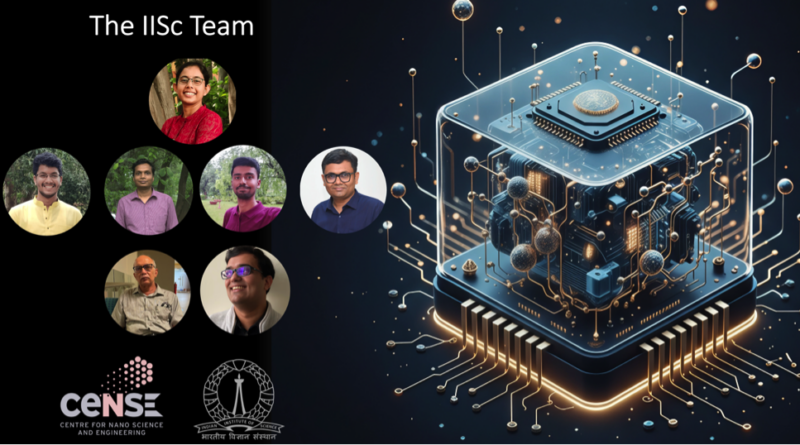
The research, led by Dr. Sreetosh Goswami, Assistant Professor at the Centre for Nano Science and Engineering (CeNSE), suggests a possible convergence between two long-standing scientific pursuits: finding alternatives to silicon-based electronics and developing neuromorphic computing hardware inspired by the human brain.
🔬 From Silicon Limits to Adaptive Molecular Matter
For decades, researchers have attempted to replace silicon with molecular components. However, molecules inside electronic devices behave as complex, interacting systems, where electron flow, ion redistribution and structural variations produce nonlinear and unpredictable responses.

Similarly, neuromorphic computing has sought materials that naturally learn and adapt, rather than merely simulate learning through engineered circuits. Most existing platforms rely on oxide materials that imitate brain-like behavior but do not intrinsically embody intelligence.
The IISc study indicates that molecular matter itself can be programmed to behave intelligently.
⚙️ One Device, Multiple Functions
The IISc team developed tiny molecular devices capable of performing multiple electronic roles. Remarkably, the same device can function as:
- A memory element
- A logic gate
- A selector
- An analog processor
- An electronic synapse
The function depends solely on how the device is electrically stimulated, showcasing an unprecedented level of adaptability.
“It is rare to see adaptability at this level in electronic materials,” said Dr. Sreetosh Goswami. “Here, chemical design meets computation—not as an analogy, but as a working principle.”
🧪 Chemistry-Driven Intelligence
The breakthrough is powered by precise molecular chemistry. The researchers synthesized 17 distinct ruthenium-based molecular complexes, carefully modifying their ligands and ionic environments.
These subtle chemical variations allowed the same molecular system to:
- Switch between digital and analog behavior
- Operate across a wide range of conductance values
- Exhibit stable yet reconfigurable electronic states

The molecular synthesis was led by Dr. Pradip Ghosh, Ramanujan Fellow, along with Dr. Santi Prasad Rath, former CeNSE doctoral researcher. Device fabrication was carried out by Pallavi Gaur, PhD scholar and first author of the study.
“With the right molecular chemistry, a single device can store information, compute with it, or even learn and unlearn,” said Gaur.
📐 Theory Meets Experiment
A key advancement of the study lies in its theoretical framework, long missing in molecular electronics. The IISc team developed a transport model grounded in many-body physics and quantum chemistry, enabling prediction of device behavior directly from molecular structure.
The framework explains:
- Electron transport through molecular films
- Oxidation and reduction of molecules
- Rearrangement of counterions
- Stability and relaxation of molecular states
This predictive capability marks a turning point in designing function-driven molecular electronics.

🧠 Toward Intrinsically Intelligent Hardware
By embedding memory and computation within the same material, the research opens new possibilities for neuromorphic hardware, where learning is encoded directly into matter rather than imposed through software.
The team is now working on integrating these molecular systems with silicon chips, aiming to create energy-efficient, adaptive AI hardware for the future.
“This work shows that chemistry can be an architect of computation, not just its supplier,” said Dr. Sreebrata Goswami, Visiting Scientist at CeNSE and co-author.