National Consultation at NALSAR Calls for Rights-Based Review of Juvenile Justice Law
Reassessment of Treating Children as Adults under Juvenile Justice Law
Hyderabad |
A two-day National Consultation on “The Treatment of Children in Conflict with the Law as Adults: Rights Implications” was organised at NALSAR University of Law, Hyderabad, to mark ten years of the Juvenile Justice (Care and Protection of Children) Act, 2015. The consultation critically examined the legal, procedural, psychological, and constitutional consequences of transferring children to the adult criminal justice system.
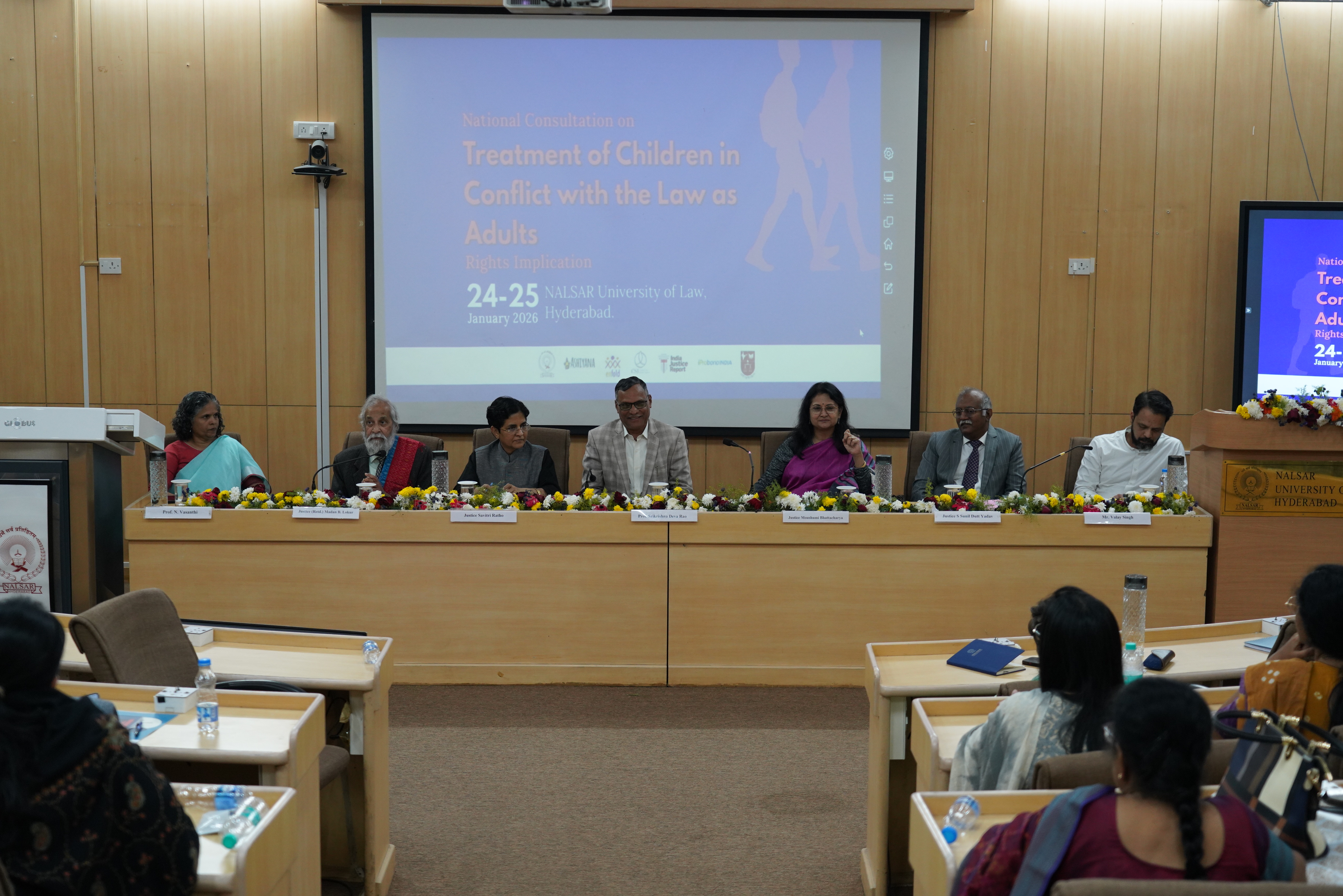
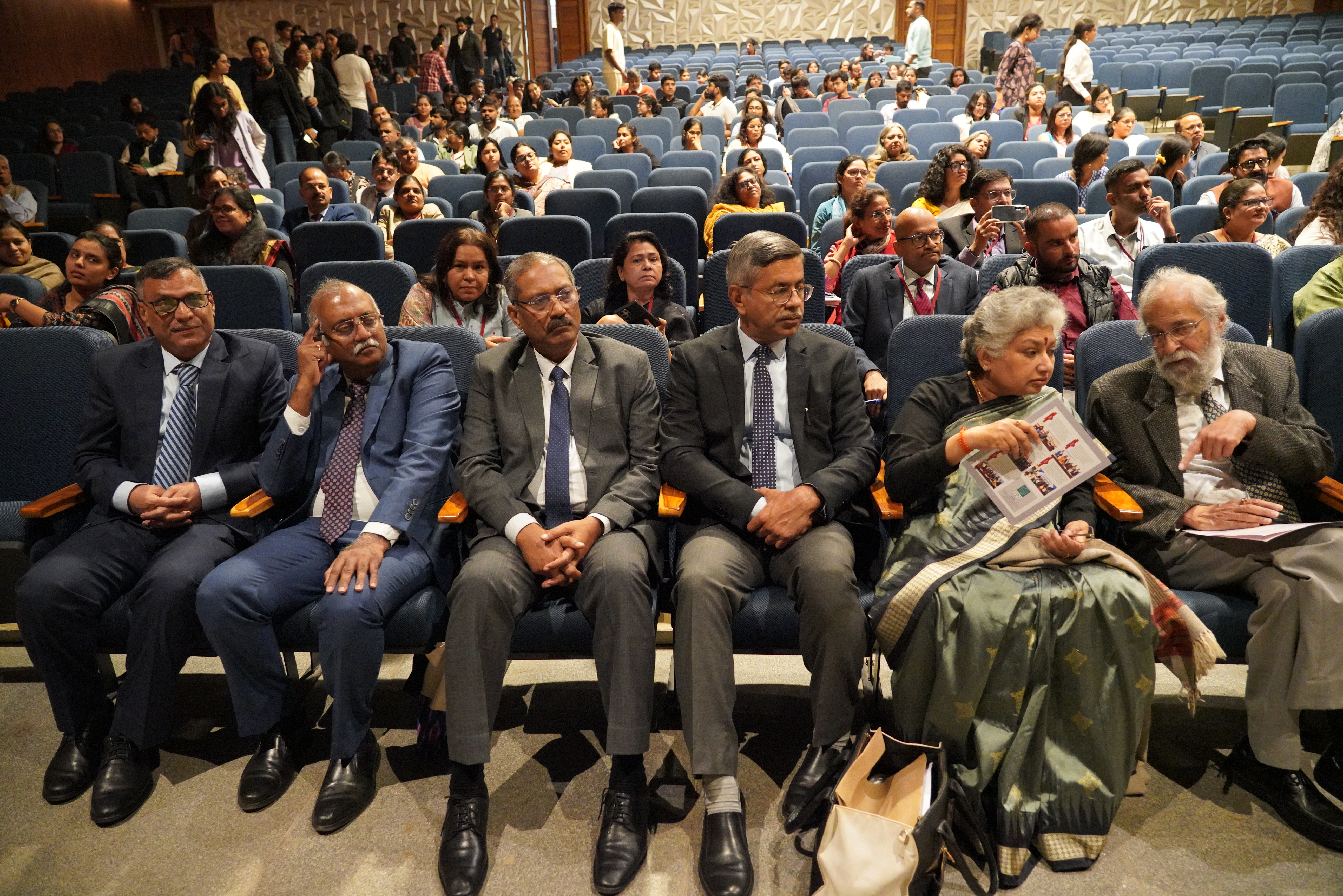
The consultation brought together judges, judicial officers, lawyers, Juvenile Justice Board (JJB) members, probation officers, mental health professionals, researchers, civil society organisations, media professionals, and individuals with lived experience, creating a multi-stakeholder forum for rights-based dialogue and reform.
The event was jointly organised by NALSAR University of Law, Hyderabad; Ashiyana Foundation; Counsel to Secure Justice; Enfold Proactive Health Trust; India Justice Report; iProbono India; and the Juvenile Justice Clinic–NLSIU.
Judicial Perspectives and Inaugural Address
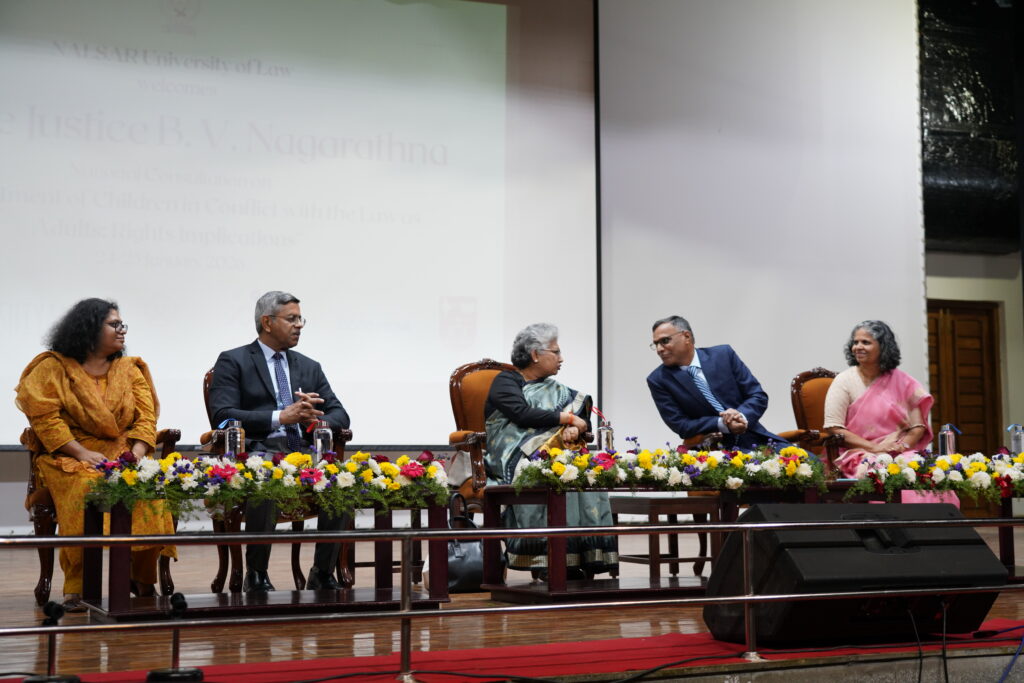
Delivering the inaugural address, Justice B. V. Nagarathna, Judge and Chairperson of the Juvenile Justice Committee, Supreme Court of India, emphasised that the juvenile justice system is rooted in reformation and rehabilitation, not punishment. She underlined the need for regular sittings of Juvenile Justice Boards and stressed that public outrage cannot dictate judicial outcomes, which must remain grounded in discipline, constitutional values, and judicial humility.
Hon’ble Justice Aparesh Kumar Singh highlighted the complexities of the Preliminary Assessment and Transfer System under Section 15 of the JJ Act, noting that the 2015 legislation marked a departure from the restorative philosophy of the Juvenile Justice Act, 2000.
Welcoming the participants, Prof. Srikrishna Deva Rao, Vice-Chancellor, NALSAR University of Law, stressed the centrality of due process in juvenile justice, describing it as “tender justice” that reflects a moral and constitutional commitment towards children in conflict with the law. He also emphasised the importance of diversion as a guiding principle across all stages of the system.
Key Rights and Procedural Concerns
Across thematic panels, participants highlighted serious concerns regarding inconsistent preliminary assessments, lack of statutory guidelines, and varied interpretations of heinous offences across states. Experts pointed to the over-reliance on mental health reports, weakening of safeguards under Section 19, and limited review by Children’s Courts.
Mental health professionals cautioned against using psychological assessments as determinative tools, emphasising that such assessments cannot predict adult criminal capacity. Participants also expressed concern that presumption of innocence is often compromised, with assessments frequently starting from an assumption of guilt rather than care and protection.
Challenges in Children’s Courts
Discussions revealed infrastructure gaps, lack of specialisation, and procedural ambiguity in Children’s Courts, especially in states without designated courts. Participants observed that Children’s Courts often function administratively with minimal scrutiny of JJB transfer orders and limited follow-up on rehabilitation.
Children tried in these courts frequently face delays, logistical challenges, limited access to records, and inadequate legal representation, making the juvenile justice process more burdensome than the adult criminal justice system.
Media Narratives and Public Discourse
A dedicated session examined the role of media narratives in shaping public perception of juvenile crime. Journalists and researchers noted that sensational reporting and populist reactions to isolated incidents fuel punitive discourse, despite evidence of declining crime trends among children. Experts warned that such narratives undermine the rationale for a separate juvenile justice system.
Criminalisation of Adolescent Sexuality
One of the most critical discussions focused on the criminalisation of consensual adolescent relationships under the POCSO Act. Speakers highlighted how mandatory reporting and rigid age-of-consent provisions disproportionately criminalise boys while institutionalising girls. Experts stressed that adolescent sexuality is normative and evolving, cautioning that criminalisation causes long-term harm without improving child safety.
Participants called for rethinking Section 15 transfers and age-based criminalisation, advocating for child-centric approaches that prioritise empowerment, listening to children’s voices, and recognising evolving capacities.
Data Gaps and the Way Forward
Participants underscored the absence of reliable, disaggregated data on preliminary assessments, transfers, trial outcomes, and rehabilitation. Recommendations included regular social audits under Section 55 of the JJ Act, standardised national protocols, capacity-building for all stakeholders, and collaboration with academic institutions for evidence-based reform.
Valedictory Reflections
In the concluding session, Hon’ble Mr. Justice (Retd.) Madan B. Lokur, former Judge of the Supreme Court of India, stressed the urgent need for accurate data, sustained training, and continuous dialogue to inform juvenile justice reforms.
Hon’ble Ms. Justice Savitri Ratho (Odisha High Court) and Hon’ble Mr. Justice Sunil Dutt Yadav (Karnataka High Court) reiterated that reintegration, not punishment, must remain the core objective of juvenile justice.
Hon’ble Ms. Justice Moushumi Bhattacharya (Telangana High Court) highlighted the role of social conditions, early interventions, and institutional infrastructure in preventing children from entering the justice system.
The consultation concluded with a strong consensus that treating children as adults should not be the default response under the juvenile justice framework. Participants reaffirmed the need to uphold the constitutional, rehabilitative, and rights-based foundations of juvenile justice, supported by research, data, and sustained multi-stakeholder engagement.