IISc Researchers Use Amorphous Materials and AI to Boost Magnesium Battery Performance
Bengaluru : A research team at the Indian Institute of Science (IISc) has discovered a promising way to build next-generation magnesium batteries using amorphous materials and machine learning. The breakthrough could pave the way for batteries with far higher energy density than today’s lithium-ion cells.
Magnesium batteries can theoretically store almost twice as much energy per atom as lithium because each magnesium atom can exchange two electrons instead of one. However, commercialisation has been hindered by the lack of suitable cathode materials, as magnesium ions move too slowly through the crystalline structures used so far.
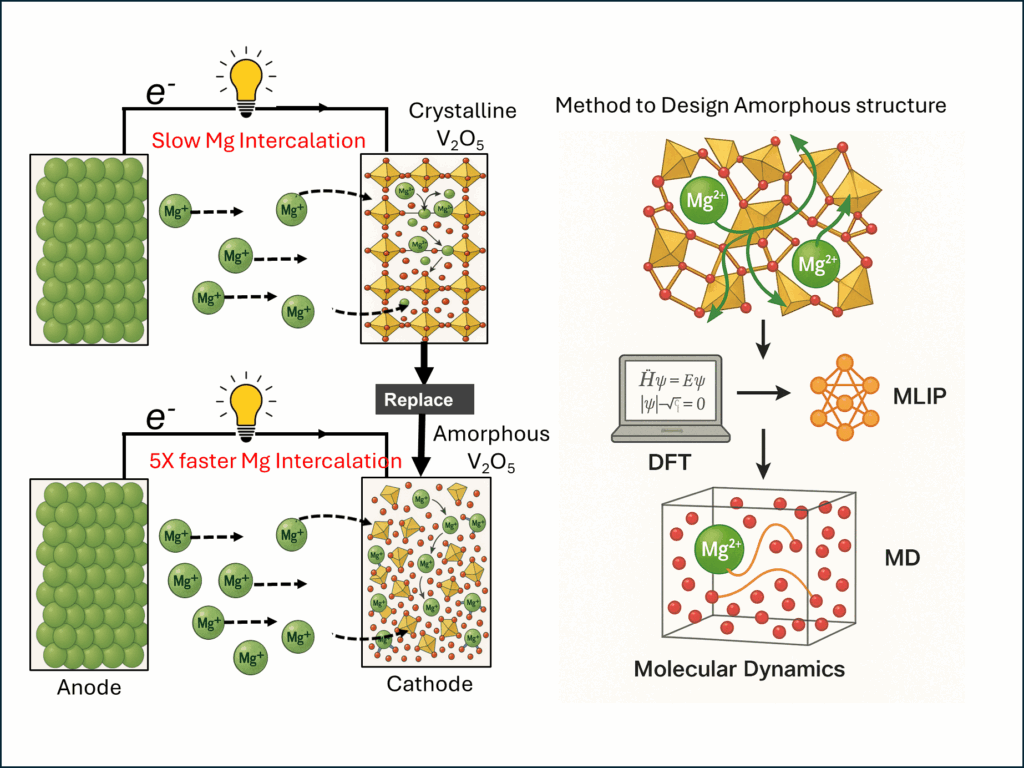
Led by Dr. Sai Gautam Gopalakrishnan, Assistant Professor at IISc’s Department of Materials Engineering, the team demonstrated that breaking this crystallinity and using an amorphous (non-crystalline) form of vanadium pentoxide can dramatically speed up magnesium ion movement.
To prove their concept, the researchers combined density functional theory (DFT) for accurate electronic modelling with molecular dynamics (MD) simulations for large-scale behaviour. They trained a machine learning model on DFT data to perform faster MD simulations, revealing a five orders of magnitude improvement in ion mobility compared to crystalline materials.
“Our work offers a completely different pathway to identify electrode materials for batteries and takes us a step closer to the commercialisation of magnesium batteries,” said Dr. Gopalakrishnan.
The team now hopes experimental scientists will test the amorphous material in real-world batteries, while also studying its long-term stability. If successful, the discovery could help create safer, more powerful energy storage systems for future electronics and electric vehicles.